Wednesday, 26 March 2014

Radio- Documentary: Aboriginal Perspectives, A New World


In our documentary we identify the importance of Aboriginal perspectives in the classroom and who should be incorporating them. We examined four different educational perspectives, including a reflection on our own personal experiences. During our research we came to an agreement that an Aboriginal perspective is a valuable component of education. This inquiry allowed us to gain a better understanding about what an Aboriginal perspective means, but we were also left with more questions. Join us as we discover the positive and negative aspects of an Aboriginal perspective, it`s integration into the classroom, and what it means to students and teachers.

Producers: Julia Martin, Amy McLeod, Sarah Hawley, and Amanda Acquisto.

Photo Credit: ASC- Migizii Agamik at the U of M Facebook page


Featured on our Radio-Documentary:
Micheline Lesk-  Métis student, in the faculty of education at the University of Manitoba
Karen Boyd- Professor, at the University of Manitoba in the faculty of education
Michelle Wiebe- Student, in the faculty of education at the University of Manitoba
Carl Stone- Advisor, for the Aboriginal Student Centre at the University of Manitoba. 

Music:One Drum By: Leela Gilday,Darling Don’t Cry By: Buffy Sainte Marie,When the Sun Sets Over the World By: Winston Wuttunee.


Tuesday, 25 March 2014

Perceptions of Aboriginal Students radio documentary

Teachers John, Laura, and Braden examine the perceptions of Aboriginal students. The basic information used in this documentary is gathered through interviews, research, and personal opinion. Opinions from educators, employers, civil servants, parents and students were collected on the topic of whether they see Aboriginal students as unique or having specialized needs in society. These opinions are contrasted with the comments of Aboriginal student Clyford Sinclair, who spoke at Aboriginal house about his personal experience in the education system and how it has affected him as an individual. Experiences with Aboriginal students of all ages are discussed and in response we give our own insights into how we may approach these students in our own classrooms, from the perspective of future teachers.

Interviews:
● Foster Mother of Aboriginal children
● Female White Early/Middle Years Teacher
● Clyford Sinclair- UMASA treasurer and UMSU Aboriginal students’ representative
● Anna - Northern hospital nurse
● Christine - Former U of M science outreach program employee
● Male Business Owner 

Songs:
● Cris Derksen - 2 Hour Parking 
● A Tribe Called Red - Electric PowWow Drum
● A Tribe Called Red - Native Puppy Love
● Winston Wuttunee and Robert Falcon Ouellete’s Aboriginal Education class - Traditional  Song

Tuesday, 18 March 2014

The Canadian Rangers: A Living History


The Canadian Rangers stand sentinel in the farthest reaches of our country. For six decades, this dedicated group of citizen-soldiers has quietly served as Canada’s eyes, ears, and voice in isolated coastal and northern communities.

How does this minimally trained and lightly equipped force make a meaningful contribution to national defense and to sustainable communities? One of Canada’s leading experts on northern issues answers this question using official records, extensive interviews, and on-the-ground participation in Ranger exercises from coast to coast to coast. Lackenbauer reveals how the Rangers have evolved into a flexible, inexpensive, and culturally inclusive way for Canada to "show the flag." The Rangers offer living proof that military activities designed to assert sovereignty need not cause insecurity for residents of remote regions. Local knowledge, stewardship, and national security prove compatible and mutually reinforcing.

The Canadian Rangers also tells the untold story of a successful partnership that has developed between the Canadian Forces and Aboriginal peoples, a partnership rooted in traditional knowledge and skills and characterized by acceptance and cross cultural understanding.

It was researchered and written by Dr Whitney Lackenbauer a professor in the Dept of History at St Jerome University.


https://archive.org/details/LackenbauwerRangerAndCandianMilitaryMixdown 


Friday, 14 March 2014

Residential Schools, Courts, Structual Violence, Today's Federal Government & an Electric Chair to Shock

MP Charlie Angus has penned a blog on the Residential Schools about the abuse suffered at St-Annes Residential School in Ontario and a current court case. Apparently the federal government through its lawyers has withheld key documents from the court and survivors that they are legally bound to disclose. While normally I would not deal with an issue like this I feel that this is so important in demonstrating the structural violence that Indigenous peoples are exposed to within the legal system, governments, justice system (police). While some might feel that this is a form of retroactive complaining, when the cause of justice is involved the Canadian Human Rights Act, the Universal Declaration of Human Rights should serve as guiding principals for all people involved in the administration of justice. I fail to understand how lawyers could, day after day stand in court, lie and present false information unless they understand that this is their environment (habitus) and their fields of influences are stronger and more powerful than the plaintiffs and there are zero to no consequences for their deeds except possible promotion and the fees they are paid with a holiday at a beach resort.

It should be remembered that when the Ontario Provincial Police investigated in the 1990s they found children were beaten, raped, sexually assaulted and even tortured in a home made electric chair for the entertainment of the staff. The police gathered thousands of pages of witness testimony that resulted in numerous criminal convictions. Is the current Truth and Reconciliation Commission really bring about reconciliation when the federal government does not seem part of the process, not even a disinterested by-standard.

Let the words of the court convince you.Justice Perrell's January 14, 2014 ruling was damning: "Canada's failure to produce the OPP documents about St. Anne's has compromised the IAP and denied the Claimants access to justice." The Ontario Court ruled that the Conservative government had clear legal duties to "search for, collect and provide a report about the persons named in the Application Form as having abused the Claimant... as well as any allegations of physical or sexual abuse committed by such persons, where such allegations were made while the person was an employee or student." (Ruling paragraph 134).

Charlie Angus writes "Justice Department lawyers shrugged when it came to explaining why they had presented a false evidence narrative stating "It must have been human error." This seems like a pretty weak explanation for such a major breach in legal duty. I wrote twice to Minister Justice Mackay on this subversion of legal duty. He waited over six months to respond with a letter full of vague platitudes. However, he did admit they were legally obligated to prepare an accurate narrative."

http://www.huffingtonpost.ca/charlie-angus/residential-schools_b_4920746.html?utm_hp_ref=email_share

Monday, 3 March 2014

Radio-Documentary: Combating Cultural Discontinuities


Catrina Tomchuk and Matt Duda examine the phenomenon of cultural discontinuity experienced by Aboriginal students in Manitoban schools today in an independently produced radio documentary.  They discuss what cultural discontinuity is and what is being done in the province to deal with this issue.

Featured on the show are interviews with University of Manitoba Professors Dr. Frank Deer and Dr. Yatta Kanu, Dionne Deer (Aboriginal Resource Coordinator for Louis Riel School Division), Dennis Daniels (Executive Director, Manitoba Indigenous Cultural Education Centre), Jim Sinclair (Indian and Métis Friendship Centre), Shirley Delorme-Russell (Culture and Education Resource Coordinator, Louis Riel Institute), and Michael “Redhead” Champagne (founder of Aboriginal Youth Opportunities).  They all lend their expertise to the analysis of cultural discontinuity in Manitoban schools.
In the North End on walk around tour with Michael Champagne


Friday, 28 February 2014

Exploring Racism Through Clothing : Radio Documentary

This radio documentary focused on how racism towards Aboriginal people can be seen through clothing. The main points addressed were racism through sports jerseys, traditional clothing, Victoria's Secret 2012 fashion show, and the “Got Land? Thank an Indian” t-shirts. Each member of the radio collective interviewed different people and worked together during the production of the documentary. Of the people we interviewed, only one wanted to have their names released so they will remain anonymous. 
taken from CBC Web-site


People we interviewed:
Interviewee #1
Middle-aged woman. She is of a mixed background including German, and Cherokee.

Interviewee #2
Man in his twenties. Asian background.

Interviewee #3
Man in his twenties. A former University of Manitoba student. Ojibway and Metis background.

Interviewee #4
Angela Fey
Graduate student at the University of Manitoba
   

Tuesday, 25 February 2014

Louis Bernardin et son livre - Reflexions: Louis Riel avant et apres

Louis Bernardin (Manitoba) a écrit un livre sur Louis Riel et une réflexion sur les Métis du Manitoba. Bien que Louis Bernardin ne soit pas métisse il a beaucoup côtoyé la vie des Métis. Il a forgé de nombreuses amitiés de la population metisse de St-Laurent et de St-Rose-du-lac. Dans son livre Reflexions: Louis Riel avant et apres il cherche a partager ce que il connais de la vie de la grande nation métisse et ce que il a appris en consultant les archives MARILOU qui l'ont beaucoup informé sur l'enfance, la vie, la pendaison de Louis Riel ainsi que sur les Métis ayant connu le père du Manitoba et tous les Manitobains. Enfin il tente résumer les conséquences désastreuses de la protestation de Monseigneur Béliveau fait auprès de Rome en 1917.


Ce fut un grand plaisir de parler avec M. Louis Bernardin un allié des peuples métis. S'il vous plaît profiter de l'entrevue et podcast dans les liens qui suivent.


 https://archive.org/details/47LouisBernardinFrenchMixdown

https://archive.org/download/47LouisBernardinFrenchMixdown/47%20louis%20bernardin%20french%20mixdown.mp3

Tuesday, 18 February 2014

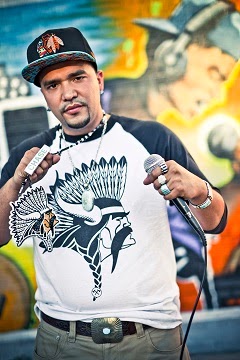
Chase Manhattan: A Musical Hip Hop Conversation

Chase Manhattan

In this musical conversation, hip hop artist Chase Manhattan speaks with guest interviewer Liz Przybylski. He shares how he puts together his music, and also talks about how family and place influence him. We listen to his track "For My Natives" together, and Chase offers thoughts about how hip hop can speak to social issues of importance in Native communities. And of course, there is a little beat boxing to round out the show.

Chase Manhattan is a Hip Hop/ Rap performing artist, and CEO of Shanob Ent. based out of the Twin Cities Minnesota. His music is influenced by his big brother and his Native American roots( Pine Ridge Oglala, Leech Lake Anishinaabe, and Muscogee Creek).

Chase's work has been nominated for a number of awards, 2009's "The Backside" was nominated for Best Hip Hop/Rap Album at the Northern American Indigenous Image Awards (NAIIA) in Albuquerque, New Mexico. It was also nominated for the 2009 Native American Music Awards (NAMA) in the category of Best Hip Hop/ Rap Album. In 2010/2011 he worked with organizations such as First Nations Composers Initiatives (FNCI), to develop community and culture though music.

To Learn More (podcast with interview)
https://archive.org/details/20140213341 
 https://archive.org/download/20140213341/20140213-341.mp3  

Thursday, 6 February 2014

Human Rights:First Nations teen Stephen Bunn was accused of smoking drugs after smudging by his school

Here is an interesting case of a Indigenous student who is using traditional beliefs (smudging) on his own time and not at school is forced to encounter the bureaucracy of the state. Stephen Burn has been accused of using drugs and was searched by his school. While it is legal to search students on school property it was his explanation of doing smudging that were not believed. Eventually he ended up in the principals office where he was told he must give up doing is smudge. Eventually another reason was raised that the school is scent free environment and he can no longer attend classes after having smudged. Incredibly students and staff that smoke cigarets are allowed to continue this health hazard.

http://www.cbc.ca/news/aboriginal/first-nations-teen-told-not-to-smudge-before-school-1.2524641 

The Canadian Charter of Rights and Freedoms says in section

 Everyone has the following fundamental freedoms:
(a) freedom of conscience and religion;
(b) freedom of thought, belief, opinion and expression, including freedom of the press and other media of communication;
(c) freedom of peaceful assembly; and
(d) freedom of association.

Perhaps Indigenous spiritual traditions are not religious rights.

Smudging is Indigenous physical and mental cleansing technique and tradition. It is a ceremonial way to cleanse a person, place or an object of negative energies or influences. It is also an effective method for energizing or blessing a person, place or object. Smudging can be useful when you're feeling depressed, angry, resentful, unwell or after you have had an argument with someone. It is common to smudge yourself, the space and all the guests or participants before a ritual or ceremony or celebration. You can smudge your home or work space as part of a general spiritual housecleaning. Sage is probably the most popular herb for smudging, followed by Sweet Grass. When the herbs used for smudging are tied into a bundle and allowed to dry they are called a "smudge stick". In traditional societies the herbs used for smudging are considered sacred and the smudge stick is treated with great respect.

To learn more and see his youtube video click the link
http://www.youtube.com/watch?v=5L-ktxzVwDE

Saturday, 1 February 2014

Seattle Art Museum pulls B.C. First Nation's mask from Super Bowl wager

Seattle Art Museum pulls B.C. First Nation's mask from Super Bowl wager | CTV News

http://www.cbc.ca/news/canada/british-columbia/super-bowl-wager-of-native-mask-upsets-b-c-first-nation-1.2513950 

Here is another example of  cultural misappropriation by another museum in America. Anthropologists and many museums have spent many years building relationships with Indigenous peoples that can be quickly destroyed by ignorance. The Seattle Arts Museum placed a bet with their counterparts in Denver. The winner of the Superbowl would receive a piece of art work. Seattle would lend a mask (circa 1880) which resembles a hawk created by the Nuxalk First Nation (in Bella Coola, BC) to a Denver Arts Museum. Usually the origins of these masks are less than ethical.  These artifacts often have religious significance and were often acquired in a less than honourable fashion. Seattle would receive a Frederic Remington (1895) bronze The Broncho.


Nuxalk First Nation
Too often though the relationships between museums and Indigenous peoples are not built by all museums; the Seattle Art Museum staff apparently failed to undertake proper training at post-secondary institutions before joining their museum or follow ethics new standards. Canada has quite an extensive experience in relations with Indigenous peoples. In 1987 the Glenbow museum in Calgary spent considerable sums and time trying to understand the Indigenous world-view concerning the artifacts that that museum was displaying for their Olympic (Calgary 88) exhibit.

American museum have quite a bit they can learn from their Canadian neighbours. I conducted an interview with Dr Ruth Phillips about her book Museum Pieces: Toward the Indigenization of Canadian Museums and the controversies surrounding museums and their obligation to First Nations political and spiritual demands in North America. The ways in which Aboriginal people and museums work together have changed drastically in recent decades. This historic process of decolonization, including distinctive attempts to institutionalize multiculturalism, has pushed Canadian museums to pioneer new practices that can accommodate both difference and inclusivity. Drawing on forty years of experience as an art historian, curator, exhibition critic, and museum director, Ruth emphasizes the complex and situated nature of the problems that face museums, introducing new perspectives on controversial exhibitions (1967, 1988) and moments of contestation (1997).

To Learn More (Podcast):
http://archive.org/download/RuthPhillipsAndHerNewBookMuseumPiecesTowardsTheIndigenizationOf/RuthPhillipsMix.mp3 


http://archive.org/details/RuthPhillipsAndHerNewBookMuseumPiecesTowardsTheIndigenizationOf

Friday, 24 January 2014

Combating Colonial Technosciece: Lessons from the Frontline

This is a conversation with Dr Kim Tallbear about a lecture she gave at the University of Manitoba about Combating Colonial Technosciece: Lessons from the Frontline (Oct 28, 2013). Kim works as an Asssociate Professor of Anthropology at Texas. Here we have a wide ranging conversation about science, genetics, genomes, Indigenous peoples, gender and how science sometimes has a false foundation on which to judge Indigenous peoples in order to advance Western political beliefs. 

To Learn More (Podcast)

https://archive.org/details/37KimTallbearMixdown 

https://archive.org/download/37KimTallbearMixdown/37%20kim%20tallbear%20mixdown%20.mp3

Monday, 6 January 2014

Racialized Policing: Aboriginal Peoples Encounters with the Police

I had a long conversation with Elizabeth Comack about her book Racialized Policing Aboriginal Peoples encounters with the Police near the anniversary of the Manitoba Justice Commission from 20 years ago.  In this wide a far ranging conversation we discussed the beautifully romantic sounding star light tours and the myths and realities surrounding these events. The culture of policing and the creation of the other. Police reproduce the order of the day and even when Aboriginal people become part of that police culture the blue becomes thicker than blood. It feeds into another controversy surrounding another blogger James Jewell and his opposing point of view on racism within Police services in Canada and Winnipeg. Is there racism within police services in Winnipeg; is the violence perpetuated against women in the sex trade based on the individual life choices on the part of those women or is it based on ethnic origin and they have little role to play except as victims?

To Learn More (podcast)

https://archive.org/details/33PolicingLizComackMixdown
Citations

Wednesday, 18 December 2013

The Sun Dance: Connecting with the Children (Media and the Great Debate)


A controversy has erupted in Manitoba. The first time since the 1960s a Sundance ceremony has been recorded. There have been many negative and positive comments about this. APTN the Canadian National Aboriginal TV Network did a three part mini series in June 2013. What are some of the reasons against or for sharing the Sundance ceremony?
At the end of the Sundance with my boys


In the 19th century up until the mid 20th century many of the traditional ceremonies were recorded both in word, but visually with photos and later in video. Many of those doing this recording were anthropologists, Indianophiles and in the 1950s and 60s Indigenous peoples themselves. There was a tendency after the 1900s to start hiding the ceremonies because religious officials and government agents would take children during the ceremonies and they had been declared illegal both in Canada and the United States

To see the video

Wednesday, 11 December 2013

Perceptions of Aboriginal Students (Radio documentary)

Summary: Albee, Kamila, and Kurt look the perceptions of aboriginal students through research, interviews, and our own opinions.  Included is an interview with Verna Kirkness, Manfred Hildebrandt, and Questions and Answers with Albee and Kurt.  This 25 minutes radio show incorporates some trendy Aboriginal electric music fused with intriguing theory’s behind the perceptions of Aboriginal students.

Producers Involved: Albee Eisbrenner, Kamila Cecelon, Kurt Hildebrandt


Songs Used:
A Tribe Called Red – Electric pow wow drum
A Tribe Called Red – Look at this
A Tribe Called Red – Electric Instrumental 
To Learn More (Radio Documentary)

https://archive.org/details/RadioDocGroup4Mixdown
https://archive.org/download/RadioDocGroup4Mixdown/radio%20doc%20group%204%20mixdown.mp3

Thursday, 5 December 2013

Metis Federation of Canada (New National Organization)

A new national organization has been formed on Nov 16, 2013. The Metis Federation of Canada interim president Robert Pilon says "The Métis Federation of Canada was formed to recognize, represent and  support Métis citizens across Canada, uniting us from coast to coast to coast.  As a grassroots organization, with representatives from all regions of this country, we are people from varying walks of life who are passionate about our history, our culture and our rights..." 

YouTube – Anglais (Robert Pilon – President): http://www.youtube.com/watch?v=4Tx8IkS45Fg
YouTube – Français (David Bouchard – Membre fondateur): http://www.youtube.com/watch?v=qIWPKFVVz1U
YouTube – Anglais (Bob Stevenson – Membre fondateur): http://www.youtube.com/watch?v=ypzGJOXI6kI
Notre project – teaser:

Facebook (https://www.facebook.com/Metisfederationofcanada) and Twitter (@metisfederation). 
The founding members are Robert Pilon, David Bouchard, Karole Dumont-Beckett, Theresa Lizotte, Dan Goodon, Hélène I Savard, Bob Stevenson, Alfred Chiasson, Daryle Desjarlais, Daniel Gilbeau, Ray Racicot, Bill Gabbani, Jim Laroche, and Deborah Bastien.

Good luck to this group of people and the cause they hold dear. It will be difficult challenging the current power structures.