Showing posts with label post-coloniality. Show all posts

Monday, 17 March 2025

The Rise and Fall of the Hudson’s Bay Company: A Trickster’s Reflection

The Rise and Fall of the Hudson’s Bay Company: A Trickster’s Reflection

As I sit in my tipi drinking tea with my friend, the Trickster Coyote, this Sunday afternoon, we are surrounded by muskets, beaver pelts, and well-worn utensils. The fire gives off a warm glow, and we talk of the history of our nation and the workers at the local Hudson’s Bay Company fort, many of whom might soon be losing their jobs. Coyote chuckles, his sharp teeth glinting in the firelight, reminding me of the history of Canada and Indigenous peoples.


The Hudson’s Bay Company arrived in Cree (Nêhiyaw) territory over 350 years ago, bringing change, whether we wanted it or not. At first, they said they only wanted to trade—beaver pelts for metal pots, knives, and muskets. The exchange seemed fair. The land was vast, the animals plentiful, and their numbers were few—just a handful of Scotsmen and Englishmen, eager to make their fortunes. But Coyote laughs because he sees the irony of it all. These men who came as guests soon began to act like landlords, claiming the land beneath our feet as their own. They said the land was called Rupert’s Land, named after a prince of England. We call it Askiy.

At first, their presence was strange, but they were traders, and we were traders, too. We did not think of land ownership in the same way; we moved with the seasons, following the rhythm of the earth. But then, in 1812, they brought refugees from Scotland—families fleeing hardship, seeking a new beginning along the Red River. And the trickle became a flood. We wanted to help them, and we did, as we always have. The land they once said they only wanted to trade upon became land they claimed. What was once shared was now fenced. The buffalo herds that had sustained us dwindled, pushed aside by settlers and their cattle. Eventually, the Hudson’s Bay Company said the land had been sold to Canada. Coyote and I laugh at the thought—the audacity!

So we forced them to sign treaties, not with the government, but with the Crown. The Crown rules by the grace of God, and we, the Cree, are here because of Kitchi Manitou. It is unfortunate, but the treaties we signed with the Crown in good faith were often ignored or manipulated, and Canada even created the Indian Act, as enduring as the Hudson’s Bay Company itself. We said we would share the land as long as the sun shines, the grasses grow, and the rivers flow. But those words, sacred to us, were mere formalities to them.


Now, after centuries of dominance, the once-mighty Hudson’s Bay Company is struggling. The company of empire, which once controlled trade routes and dictated policies, now fights to stay afloat. They prioritized profit above all else, and now, they are victims of their own philosophy. Make money at all costs—that was their way. But now, the cost may be their own existence.

Ironically, an offshoot of their old rival, the North West Company, still thrives. It sells food and supplies in remote Indigenous communities, where prices are exorbitant, but demand never fades. They are often the only game in town. Coyote shakes his head, knowing that as long as there is money to be made, someone will always step in to fill the void.


There is a strange sadness in watching an old adversary and friend disappear. We built this country together in ways that history books rarely acknowledge. We gathered at their forts, traded, laughed, married, and sometimes fought. Their blankets and guns became part of our lives, and our furs and skills became part of their wealth. And though the nation we helped build would later betray us, we were there, side by side, from the very beginning.


Now, the Hudson’s Bay Company is but a shadow of its former self. The empire they once claimed is slipping from their grasp, just as they once took the land from us. Coyote grins, knowing that change is constant, that the land endures, and that we, the people of this land, are still here. Perhaps, in the end, that is the greatest irony of all. We will always be here.

The empire has come, the empire has gone,
The Nêhiyawak still stand strong.
We watch over this land with pride,

 

Wednesday, 13 March 2013

A Life of Resilience: The Example of Elder Ralph Paul

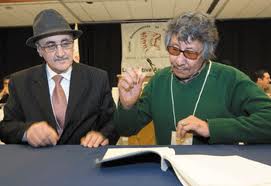
Ralph Paul taken from Nativejournal.ca
This week it is a two part interview with the very active and inspiring Elder Ralph Paul from English River First Nation. Over the course of 50 minutes we discuss his life from when at age 6 he was sent to residential school in Saskatchewan to his later years as a chief for his community. After a very difficult time away from his mother, father and family at Residential school he was eventually chosen to be one of the first Indians to attend a white school in the Battleford area. A Catholic priest believed in his abilities and felt further education would be profitable to him. Ultimately he graduated and was offered the chance to enter teachers college when he earned a one year teaching certificate and so began a very long career. During that time there were not a lot of options available for young men, teacher, priest, or book keeper, so Ralph felt lucky. Ralph has worked in schools in Ontario, Manitoba and Saskatchewan. Eventually in 1973 he was working in Thompson as a school counsellor. He was advising children to get an education yet he did not have much of an education. In 1974 he enrolled at the University of Manitoba for a Bac of Ed degree. He was one of only 13 Indian students.

He also married to a lovely Scottish lady and had two children and both have been very successful in their chosen careers. He learned form his wife how to care and love children because it was not something that you would have learned in Residential school. He in time became the best father he could. The question is why some people are successful even after the horrors of the residential school era. Why do some have an inner resilience and have been able to become successful. We discussed marital relationships and how a man and woman should not discuss politics, but focus on loving each other.

Eventually he moved back to his reservation after he had retired in early 2000s. After 8 years near the community he was elected chief. A position he held for 4 years before taking another break. There was along discussion about politics, chief, financing, funding, per diems, treaties and other issues that have been very hot in the media with a lot of misnomers and misunderstanding. Ralph felt it is important that a chief speak the truth and understand the needs of the people he represents. It is not a top down approach, but consultation and involving people in the governance and running of the reserve.

He told a number of stories about how the elders felt that are the signing of the treaties it would take 7 generation for the Dene people to surpass the Moonyas people of
Canada
. He feels we are in the 6 generation and it will be his grandchildren and my children who will be the most successful and truly rise to their full potential.
To Learn More (Interview and Podcast Part I)

https://archive.org/download/RalphPaulPartIMixdown/ralph%20paul%20part%20i%20mixdown.mp3  
https://archive.org/details/RalphPaulPartIMixdown
To Learn more (Interview and Podcast Part II)
https://archive.org/details/RalphPaulPartIiMixdown
https://archive.org/download/RalphPaulPartIiMixdown/ralph%20paul%20part%20ii%20mixdown.mp3  


Citations


Thursday, 17 January 2013

A Separate Country: Postcoloniality and American Indian Nations with Elizabeth Cook-Lynn

This is the second part of a long conversation with the Crow Creek Sioux academic and writer Elizabeth Cook-Lynn and her political book entitled A Separate Country: Postcoloniality and American Indian Nations. It is  a collection of essays where Elizabeth takes those in the ivory tower to task for espousing the idea that “postcoloniality” is the current norm for Indigenous peoples in the United States. After a long career Liz gathers writes that American Indians remain among the most colonized people in the modern world, mired in poverty and disenfranchised both socially and politically. Despite Native-initiated efforts toward seeking First Nationhood status in the U. S., Cook-Lynn posits, Indian lands remain in the grip of a centuries-old English colonial system—a renewable source of conflict and discrimination. She argues that proportionately in the last century, government-supported development of casinos and tourism—peddled as an answer to poverty—probably cost Indians more treaty-protected land than they lost in the entire nineteenth century. Using land issues and third-world theory to look at the historiography of the American Plains Indian experience, she examines colonization’s continuing assault on Indigenous peoples. We also discuss the idea that Native Studies still has a lot of work to do in creating a more rigorous discipline, the difficulties in producing work while working within academia and the anger of writing about a cultural genocide.

Elizabeth Cook-Lynn, a member of the Crow Creek Sioux tribe, was born in Fort Thompson, South Dakota, and raised on the reservation. She is Professor Emerita of English and Native American Studies at Eastern Washington University in Cheney, Washington.

Liz says “The final responsibility of a writer like me … is to commit something to paper in the modern world which supports this inexhaustible legacy left by our ancestors...and yes I am angry.”

To Learn More: (Interview Podcast)


http://archive.org/download/ElizabethCook-lynnASeparateCountryPostcolonialityAndAmericanIndian/AtTheEdgeOfCanada-SeparateCountryMainMixdown.mp3


Citations